Friday, December 14, 2018

Doot Sphere

In the erotic fourth dimension, spheres exist only as pseudospheres—the exact opposite of regular spheres.

This is a pseudosphere: 

    A child asks: 
    Why does a pseudosphere look like two trumpets placed honker to honker?
    If a pseudosphere is the opposite surface curvature of a sphere, then isn’t the inside of a sphere a pseudosphere?

    A wise adult responds: 
    So a sphere’s surface has no depth. Imagining the “inside” of a sphere is wrong. There’s no inside or outside because it isn’t like a shell or a ball or a barrier.

    You’re actually just picturing a different perspective on a normal sphere when you say “inside.”

    In terms of inside and outside of a sphere, you have to think of a pseudosphere as looking at the inside of a sphere from the outside of the sphere (not like see-through style, but the inside IS the outside).

    Also, the technical term for a trumpet’s “honker” is “doot pit.”

The "doot pit" is also known as the "doot cup." Particularly in reference to trombones. When two trumpets are placed doot pit to doot pit or doot cup to doot cup, a pseudosphere is born. The doot sphere is the purest expression of an erotic four-dimensional union.

Trumpets and trombones cannot be place together, doot to doot. Rather, they can be placed together doot pit to doot cup and cetera. But what they form is neither a pseudosphere nor a doot sphere, but a "pseudodoot."

Friday, October 17, 2014

Interview - Baratta / Applin / Watt

The following is an interview I conducted with Carl Baratta, Isak Applin and Oli Watt over email about their collaborative woodcut prints, which are featured in the exhibition They Pass Unseen In the World at SideCar.

Isak Applin, Carl Baratta & Oli Watt • What's Time to a Disappointed God II • 2012 •
woodcut on paper • 24 x 24 inches

ERIK WENZEL: Can you tell me a little about the process, how the collaboration came about and so on?
Were there any historic precedents you were looking at or specific artists/groups? I guess it tends to be a common read with wood blocks, but the images I saw made me think of German Expressionism. Particularly with the wild nature imagery.

CARL BARATTA: I'm waiting for some paint to dry (my dog licked some of a new painting off and now it's repair city USA/ bummer city, USSR). [Baratta paints with egg tempera—dogs can’t resist.]

Anyway, to answer your questions: I can speak for the process I have with those guys but Isak and Oli can explain their collaborations. Isak and I pass wood blocks back and forth. We both draw on them and talk about ideas for moods and composition. Sometimes we draw on un-carved areas and hand it to the other guy, as a guide to what we think should go next. But we don't always follow what the other person drew. Since we both draw and carve, Isak tries to draw like me and vice versa, same with the carved drawing marks. What ends up happening is we still kind of look like ourselves when carving/drawing but it creates intermediary marks that look like both of us, so the image is unified.

Wednesday, September 03, 2014

Ger van Elk

“What I want is a realistic depiction of unrealistic situations”
said Ger van Elk in a 1977 interview. (Via Artforum.com's obituary)

Van Elk's sensibility was characterized by simple, humorous and often touching gestures. The artist's direct approach is perfectly on display in the piece he contributed to Gery Schum's Fernsehgalerie. In the 1960s and 70s Gerry Schum ran a television gallery, an entity whose exhibitions existed only as broadcasts on German television. For the exhibition themed "Identifications" van Elk produced the work seen below.

Ger van Elk died on August 17th at the age of 73.

Ger van Elk • The Well-Shaven Cactus • 1970 • from Indentifications  - Fernsehausstellung II, Fernsehgalerie Schum

For you videophiles out there, you can also find a high quality transfer on vimeo.


Thursday, July 10, 2014

JULY 10, 2014

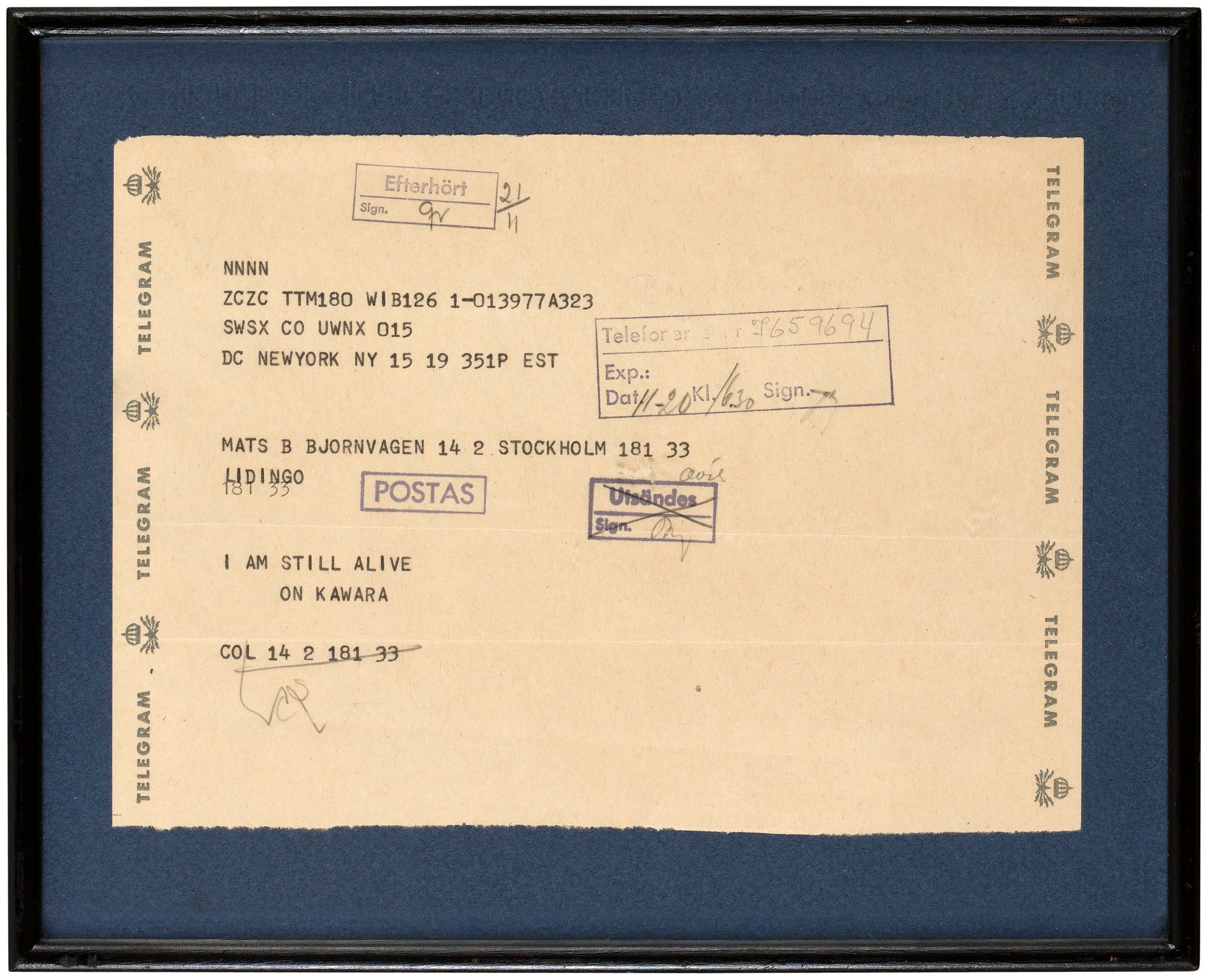
On Kawara • I AM STILL ALIVE • telegram sent in 1979 • via Bukowski's


JAN. 2, 1933

JULY 10, 2014

Tuesday, April 08, 2014

Rene Ricard

I met Rene Ricard in 2002 when he came to give a lecture at the School of the Art Institute of Chicago where I was a student. Ambitious young artist and writer that I was, I set up an interview with him. Instead of a brief chat, I was pulled into his frenetic world. I only spent a short week with him, but it was a life changing experience, something I suspect happened with almost everyone whose life intersected with his. Rene (no accent mark!) passed away in early February.


Q & A SESSION
Rene in 2003 • Nancy Smith, artnet

“The clubs were just filled with all these... ‘Young geniuses.’ Of course that’s all gone now. The whole art world is dead. No one goes to the clubs anymore, there’s nothing interesting happening.”

“But maybe–not to be brash.”

“Oh, please, be brash.”

“Not to be brash.”

“Yes, yes, get on with it.”

“Maybe you just don’t know where any of the good clubs are.”

“Yes, yes, I’m old and boring and nobody loves me. I don’t get invited to any of the good parties. Is that what you mean, you little bitch?” Gasps, silence and then laughter. Rene Ricard takes a drag from his unfiltered Camel cigarette, one of many he’s been chain-smoking throughout his lecture. “…Or whatever you are?” Holds the fag daintily and gently taps the ash off. “Or did I hit the nail right on the head?”


THE REAL ANDY

In the early 1960s, when Rene was seventeen he saw one of the Warhol Flower paintings at the Institute of Contemporary Art in Boston. He stared at it until the museum closed; he’d been sitting there for three hours. After that he immediately went to New York and joined the Factory. He had a Screen Test, he was in Chelsea Girls and he was one of Warhol’s Superstars.

Rene Ricard (left) with Andy Warhol (center) during the Factory days • photo via Hotel Chelsea Blog

“Can I ask you a gossipy question?”

“Oh No! Gossip. No, go ahead. But just one.”

“So can you talk about the fight you had with Andy?” I asked.

“We had so many! Ha!”

Monday, January 27, 2014

The Production Line of Happiness

Art or Idiocy congratulates Christopher Williams on his large scale museum exhibition,  surveying his 35-year career, on view at the Art Institute of Chicago through May 18th.


Christopher Williams
For Example: Chaton sjouant avec un appareil photo dans le style d'une photographie conceptuelle (Revision 13)
via Fotointeres


Friday, November 22, 2013

Family History / World History

Guest contribution from Helen Wenzel Moss

It was sometime in the 1960's Mama told me the story of how our family knew the Oswald family. She said we knew the family through Christ Lutheran Church. The father was an insurance collector who came by our house on Independence Street in the late 1930's to collect payments on an insurance policy bi-weekly or monthly, as was the practice during those times. Mama said he was a very nice, pleasant man. Unfortunately he died very suddenly from a heart attack about two months before his second son was born. The Oswald mother, Marguerite, was in hardship from the loss of his income and with children to support. When the youngest son was a few years old, she put the children in the Bethlehem Children's home. Christ-Bethlehem Lutheran School was on the Bethlehem property. My sisters Faith and Judith, and brother Bruce attended school there at the time. Judith went to school with an older son of Marguerite Oswald.

Mama never thought of the Oswalds again until late in 1963. In 1963 Mama worked for the National Bank of Commerce at 210 Baronne Street (at the corner of Common Street) in New Orleans’ Central Business District. Uncle Fritz was manager of Jefferson Hardware Store at 4209 Magazine Street in Uptown New Orleans. After work, Mama would walk the three blocks to the corner of Camp Street and Common Street. She would wait there in front of the old New Orleans International Trade Mart building. Uncle Fritz would drive downriver and pick her up to go home in Gentilly.

While Mama waited there, she noticed a young man handing out flyers. It was not unusual for people to hand out flyers in New Orleans at this time for all sorts of causes. She mostly studied him because there was something familiar about the way he looked. She felt like she knew him but couldn't quit place him. When the news came out that Lee Harvey Oswald had handed out pro-Castro flyers on the corner of Camp and Common Streets in summer of 1963, Mama realized why the young man had looked so familiar. He looked very much like his father did when he was her insurance man.


Friday, November 15, 2013

Is a Pound of Passivity Worth A Pinch of Pique?


I do not want to document my starting points, turning points, high points, low points, good points, bad points, stopping points, lucky breaks, bad breaks, breaking points, dead ends, breakthroughs or breakdowns.


Robert Morris • Untitled (Scatter Piece) • 1968 - 9 • felt, steel, lead, plated zinc • plated copper • aluminum & brass
Installation view at the Art Institute of Chicago • photo: Art or Idiocy?

It will be interesting to see what Robert Morris has to say tonight at the University of Chicago when he delivers his public presentation entitled IS A POUND OF PASSIVITY WORTH A PINCH OF PIQUE?

The following is from "Robert Morris on Silence" posted on the Critical Inquiry blog in 2011. You may notice the curious detail that the CI website runs counter to The Chicago Manual of Style and puts the traditional double-space at the end of sentences. Thanks to Philip von Zweck for sharing.

One of the more inexcusable forms of talking comes in the form of those cultural events called art symposiums.  Now that the role of curator in museums has metastasized to truly horrifying dimensions, it is necessary to keep these culture mavens busy by having them dream up completely irrelevant culture fests.  As an aging artist I am still on occasion invited to these stupid shindigs.  For years I made up excuses for not showing up.  But now I have fashioned an all-purpose document of reply, which goes like this:

Friday, October 11, 2013

Amalia Pica / MCA Chicago

Amalia Pica • Stabile (with confetti) • 2012 • paper & sellotape • dimensions variable
Installation view & detail at Kunst Halle Sankt Gallen, Switzerland • via Herald St

I was recently looking at a website that specializes in selling art. Its fairly detailed cataloging system works well if you are selling Matisse etchings but not so much for today’s art. One of the categories to be filled out for each work is “style.” The style for recently made artworks is “contemporary” which sounds humorously inadequate. After all, doesn’t art today consist of so many different disciplines, genres, media and approaches that it is impossible to think of it as a single style? But if there’s one thing to be gleaned from the wealth of biennials, triennials and art fairs, it’s that contemporary art most definitely has a “look.” It’s a style composed of clever gestures and smart moves. Working across multiple disciplines and media is an aesthetic position.

Thursday, August 08, 2013

How Much Can I Get For This Used Van Gogh?

Marketplace, a program highly recommended in general for its thorough and intelligent reporting on economics for the common man, has a feature today on the ongoing situation in Detroit. Lizzie O'Leary interviews Detroit Institute of Arts Director Graham Beale. The DIA's collection has become the public face of the debt crisis with the City eying it like a drug addict desperately trying to get some fast cash. You can read the interview HERE or listen to the segment embedded below.

Karl Scmidt-Rottluff • Cactus in Bloom • 1919 • oil on canvas • 26.25 x 29.5 inches
City of Detroit Purchase • Detroit Institute of Arts

This painting by German Expressionist Karl Schmidt-Rottluff purchased for the DIA by the City of Detroit is one of the contested works now being appraised by Christie's auction house. Even if the works, which are expected to be valued in the many millions, were all sold to the highest bidder the proceeds wouldn't put much of a dent in the City's debt, which is estimated to be 18 billion dollars.


Tuesday, July 30, 2013

Dust and Water

The idea of a random space in Manhattan’s SOHO neighborhood, amidst all the other cramped spaces, filled with dirt is fascinating. What other strange things are hidden amongst the stacked shoeboxes that make up some of the world’s most pricey real estate?

The New York Earth Room (Walter De Maria, 1977) is located in an expansive gallery filled with waste-high dirt. You can’t photograph it, or walk on it. You just look at it, feel the moisture and smell the earth. It’s frozen in time. It consists of a vast main space once site to large-scale installations by the likes of Dan Flavin, and perhaps most intriguing, a smaller gallery, the project room, nestled in the back. You can catch a glimpse inside, see that the dirt continues, and spot a few light cans and then only imagine what is unseen. It’s a bit like imagining what is happening at the wreck of the Titanic at this moment. Or inside one of the pyramids. The experience most impressed upon me outside the odd smell of fresh earth, notable in a city often noted for its less than fresh odors, was the forced perspective. As a viewer, you are allowed a very narrow vantage and are left wondering what it would be like to stand at tantalizingly unreachable vantage points.

Entrance to The New York Earth Room • photo: Art or Idiocy?

The Earth Room is periodically tilled, watered, and weeded so that it is always fresh. By now most of the little plants and things that had been carried with the soil are gone. The New York Earth Room was the final exhibition at Heiner Friederich Gallery in 1977. It’s now maintained by the Dia Art Foundation, which Friedrich co-founded, and has been on continuous view for over 30 years. While the work itself is quite amazing, quite literally a gold standard of “Earth Art” what makes it stand out is the context in which it exists. The gallery has long since closed, but its final exhibition continues in perpetuity. It is kept lively and new like the day it was installed. The white cube, like an unchanging tomb, is also free of time.

To think of the Earth Room in terms of burial and, in its perpetual state of newness, a type of immortality is irresistible. After all, what is the work of art but a way for the artist to live forever? What is the desire to participate in history other than a way to carry on after you art gone? It’s like having children, but on a grander, less mundane scale. But then again, it is The New York Earth Room and other works fostered by the Dia that have attained a certain eternity more than their creators.

Boris Groys’ essay “On the New” seems incredibly relevant here:

It is a difference not in form, but in time—namely, it is a difference in the life expectancy of individual things, as well as in their historical assignment. Recall the ‘new difference’ as described by Kierkegaard: for him the difference between Christ and an ordinary human being of his time was not a difference in form which could be re-presented by art and law but a nonperceptible difference between the short time of ordinary human life and the eternity of divine existence. If I move a certain ordinary thing as a readymade from outside of the museum to its inner space, I don’t change the form of this thing but I do change its life expectancy and assign to it a certain historical date. [“The New York Earth Room, 1977” still on display in 2013] The artwork lives longer and keeps its original form longer in the museum than an ordinary object does in “reality.” That is why an ordinary thing looks more “alive” and more “real” in the museum than in reality itself. If I see a certain ordinary thing in reality I immediately anticipate its death—as when it is broken and thrown away. A finite life expectancy is, in fact, the definition of ordinary life. So if I change the life expectancy of an ordinary thing, I change everything without, in a way, changing anything.

This nonperceptible difference in the life expectancy of a museum item and that of a "real thing" turns our imagination from the external images of things to the mechanisms of maintenance, restoration, and, generally, material support—the inner core of museum items. This issue of relative life expectancy also draws our attention to the social and political conditions under which these items are collected into the museum and thereby guaranteed longevity. At the same time, however, the museum’s system of rules of conduct and taboos makes its support and protection of the object invisible and unexperienceable. [The Earth Room being closed to visitors during the summer months for maintenance] This invisibility is irreducible. As is well known, modern art tried in all possible ways to make the inner, material side of the work transparent. But it is still only the surface of the artwork that we can see as museum spectators: behind this surface something remains forever concealed under the conditions of a museum visit. [You cannot photograph it, you cannot walk on it, enter into it, only view it from without, from the entrance of the gallery that has a regular wood floor and from behind a glass enclosure.] As a spectator in the museum, one always has to submit to restrictions which function fundamentally to keep the material substance of the artworks inaccessible and intact so that they may be exhibited "forever."

Entrance to The New York Earth Room • photo: Art or Idiocy?

Indeed the idea of carrying on an exhibition indefinitely, one made up of such a simple gesture as fresh earth replacing the floor of an otherwise empty gallery, is the perfect example of Groys’ position. For it’s not only a single work being preserved, or even a final exhibition, but a moment in time made up of all these things.

Even if the material existence of an individual artwork is for a certain time guaranteed, the status of this artwork as artwork depends always on the context of its presentation in a museum collection. But it is extremely difficult—actually impossible—to stabilize this context over a long period of time. This is, perhaps, the true paradox of the museum: the museum collection serves the preservation of artifacts, but this collection itself is always extremely unstable, constantly changing and in flux. Collecting is an event in time par excellence—even while it is an attempt to escape time.2

But for now we can revel in The New York Earth Room’s apparent timelessness, the thoroughly corporeal work’s simulated existence outside of corporeal reality— even as the gallery that hosted it, and now its maker—have succumbed to temporality.

Walter De Maria died at the age of 77 last week.

____________
1. Boris Groys, Art Power (Cambridge: MIT Press, 2008), 36 - 37.
2. Ibid, 39.

Sunday, July 14, 2013

Fear of A Black Planet

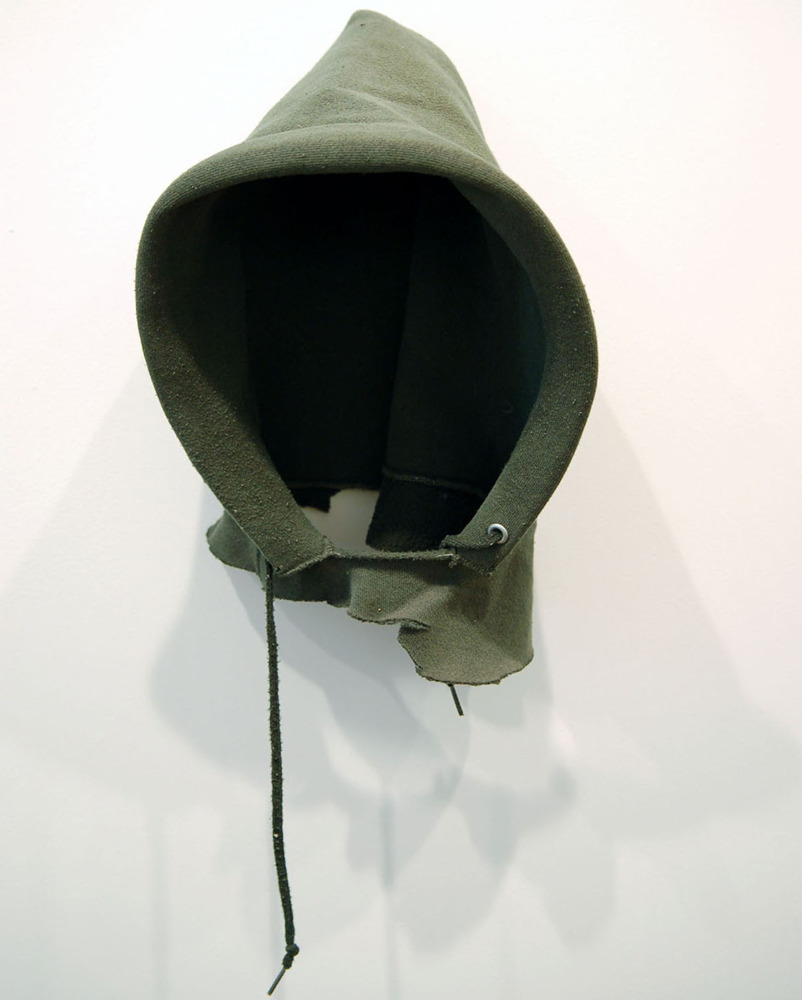
David Hammons • In the Hood • 1993 • athletic sweatshirt & wire • via Peripheral Noise


Hood (e.g. Executioner, grim reaper, hoodie, hoodlum,
hostage, klansman, neighborhood, prisoner, S&M, serial killer)


Thursday, July 04, 2013

I Like America and America Likes Me


Joseph Beuys • I like America and America likes Me • 1974
Print on paper • 569 x 543 mm • via Tate


Happy Fourth of July. Joseph Beuys likes America.

In May 1974 the German artist, teacher, shaman and social sculptor Joseph Beuys arrived at JFK Airport in New York. He was rushed to an ambulance and wrapped in felt, the sickness in the air overcoming him. The ambulance, sirens blazing, took him to René Block gallery where a caged off area containing hay and a live coyote waited for him. Beuys spent the week communing with the spirit of America (embodied by the coyote), performing a healing and cleansing act. I like America and America likes Me, marked the artist's first visit to the US and further developed his ideas of the artist/shaman as healer.

This notion is at the core of Beuys' personal mythology, beginning with his origin story fit for a super hero. After crashing in Siberia as a Luftwaffe pilot during WWII, he was nursed back to life by wandering Tartars. They covered him in fat, and as in I like America and America likes Me, they wrapped him in felt. These materials became motifs in his work, addressing the question, "Why do you use ____ in your work?" artists regularly face in quite an inventive way.

It's interesting to look at the complex belief system Beuys authored in comparison to the myths surrounding successful artists today. Beuys' artist persona was based on spiritualism and faith in art, whereas today artists' backgrounds are often amount to unique selling points aimed at giving them an edge in grant applications, filling niches within collections, or simply standing out as a specialized commodity.

Celebrate the spirit of America and heal with Joseph Beuys by watching this video. It contains documentation of the performance and discusses the artist's work in general.


Tuesday, June 25, 2013

Lecture Notes: Thomas Baylre

German artist Thomas Baylre is part of a lesser-known contingent of artists, including Peter Roehr, who came up in the 1960s alongside Sigmar Polke and Gerhard Richter. If ever there was a “Capitalist Realist” it would be Bayrle. In the last few years his profile has risen meteorically. The graphic artist once rumored to have designed the logo for the RAF has been featured in a major installation at dOCUMENTA (13), exhibitions at Air de Paris and Gavin Brown’s Enterprise, and a career survey at WEILS Contemporary Art Centre, all within the last year.

Thomas Baylre delivered a lecture for the Society for Contemporary Art at the Art Institute of Chicago in the spring of 2013. Here are the highlights from that talk:

Thomas Bayrle • billboard installed outside Gavin Brown's Enterprise • 2012 • photo: Art or Idiocy?

I will say 2 – 3 words about my so-called ‘career’.

I was not always aware if I’m a real artist or not.

Apprenticeship in weaving. Like Sculpture. The weaving of society. It is also like mapping.

I am not willing to do anything bigger than is absolutely necessary… Technically.

Chairman Mao brought the potato to China in 1957 because he didn’t want to be dependent on rice. I had a collection of magazines from China and was struck by ads that say, ‘Potatoes only grow if you read the Mao bible’ and other crazy fantasies. I saw stupidity in advertising in the West and in China. Stupidity here and stupidity there. Organizing masses in China for their purposes and in the West we must organize the masses through advertising to buy products.

Thomas Bayrle • Kartoffelzähler (Potato Counters) • 1968 • color screenprint on paper • photo: Art or Idiocy?

It was surrealism, they had to read the Mao bible to make potatoes grow. It is most crazy that it worked.

I tried to join the Leninists and Maoists, but they said, ‘You paint the figures with ties and we cannot have that.’ I learned they are impossible to work with. Stupid people. Any artists trying to work with them learned quickly, it’s not possible.

In World War II women cleaned as ideology, then after the war as products. Always cleaning.

Having US troops stationed in Frankfurt was very important. Since they were drafted, the intelligence of the United States was all there. Plus jazz.

A lot of my images were asked for by advertising agents: ‘Why not try our Glücksklee Milch?’ But they didn’t like it so much. So I kept it, I liked it.

Thomas Bayrle • installation view of "All-in-One" at WIELS Contemporary Art Centre, Brussels • photo: Sven Laurent

Love and butter.

The figures make the image of what they dream.

Chickens are not happy, but they look happy.

When I did these things I did not think about ideology. I just thought, ‘Here is a terrible man, I will make him out of his mustache.’
Thomas Bayrle • Stalin • 1971 • color screenprint on gray wove paper • 836 x 609 mm
The Art Institute of Chicago

There was no criticizing. I was not criticizing technology. I just like the telephone in my mother. We didn’t even have a telephone at home.

Thomas Bayrle • Telefonbau-Normalzeit (Telephone AT&T) • 1970
Screenprint in colors on wove paper • 35 1/4 x 27 inches (89.5 x 68.6 cm) • edition of 25

Make an image out of images. Make a super image.

Why does Orson Welles have wheelbarrows? His lips looked like wheelbarrows.

My work is like Japanese pod hotels.

We should see the production of everything. This is why I take students on field trips—they should see what’s behind the curtain.

Everyone wants his Mercedes but also wants to get into heaven.

I think without humor nothing is possible.

It comes from the moment when you have to say, ‘I can’t do it any better. I can’t make it perfect.’

I’m not making an ideology out of it, but I do most of it myself. It is also meditation.
Thomas Bayrle • Kartoffelzähler • installation view (with R.B. Kitaj painting) in "Der Geteilte Himmel"
(The Divided Heaven) at the Neue Nationalgalerie, Berlin • 2011 • photo: Art or Idiocy?


Thursday, May 30, 2013

Interview with Tania Bruguera


I'm very excited to announce that my interview with Tania Bruguera has been published on ArtSlant. I’ve been working on it with her for a few months, and I am proud of what it achieves—we cover a number of issues that are pertinent to the current state of contemporary art. Bruguera’s stances on topics ranging from class, education, labor, and professionalism in the art world will hopefully spark much-needed debate.

"It is a process of excitement about the impossible made possible; which is also an aesthetic moment. Aesthetics have shifted from the craft that is in the transformation of objects (natural or manmade) into the meaning for a craft to transform our selves (as a single person or as a group). It is not a stone exquisitely becoming the face of a saint in ecstasy, but the mobilization of the realization of ourselves, which by the way was also in the face of that saint." – Tania Bruguera

Read the interview


Image: Tania Bruguera • Portraits • 2004-2005 • Medium: Sound installation, performance • Materials: Space painted white, historical speeches translated into applauses, recorded applause, white speakers, white text in the wall with the historical information on the speeches, security guards with dogs randomly walking into the space • Courtesy of the artist • Photo: Rüdiger Ettl for Kunsthalle Wien

Friday, May 24, 2013

Yes I Smoke Crack


I'm not even sure where to start with "Witch House", a genre coined as a joke and then canonized by Pitchfork. It is the most interesting thing I've found of late. It combines gothy emo emotion, pretty high-pitched synth melodies from 90s rave music, slowed down vocals, the occult ...and rap. It should be the worst thing ever, and that's part of it's charm–it is horrible and brilliant at the same time, as all the best art is.

It also perfectly describes how I feel right now in the crudest hyperbolic way possible:

You ain't shit to me –nah
You ain't piss to me –uh uh
You ain't spit to me –nah
Ya bitch, you shit/you can suck a dick for me

Krawl by Salem on Grooveshark


Wednesday, May 22, 2013

Marumari


This is my favorite song right now. I keep listening to it in my head. You know a song is good when you hear it in your background idle thoughts as clear as if it were coming through your headphones. I hear its rich textures, smooth synthesized bass and lush atmosphere. I smile at the end when I the campy tribal horn that comes right out an 80s song that I can't quite place. This song sounds like trying to remember.

Birch Beer Forest by Marumari on Grooveshark


Monday, December 10, 2012

The Twinkie Defense

UPDATE: Twinkies returned. On my birthday no less.

Tomorrow morning the Hostess will deliver the last shipments of Twinkies and other beloved artificial treats to select grocery stores. Everyone knows these golden cakes that neither rot nor decay have a special place in the hearts of Americans. Few people realize, however, that the storied confections appear all throughout history. Such as in this painting by Paul Cézanne:


Paul Cézanne • French, 1839-1906 • The Basket of Apples with the Crazy Stack of Twinkies • c. 1893 • oil on canvas • 25 7/16 x 31 1/2 in. (65 x 80 cm) • The Art Institute of Chicago


Friday, November 16, 2012

Time Capsule


Artist and Art Institute of Chicago preparator Robert Burnier shares this find. A crew tearing down an old wall in the museum came upon this newspaper clipping sealed inside over 20 years ago.


Tuesday, April 16, 1991